

Guide to Travel Adapters and Converters for American Travelers

Traveling internationally from the United States means encountering different electrical standards. This guide covers everything you need to know about travel adapters and converters to keep your devices safely powered throughout your trip.
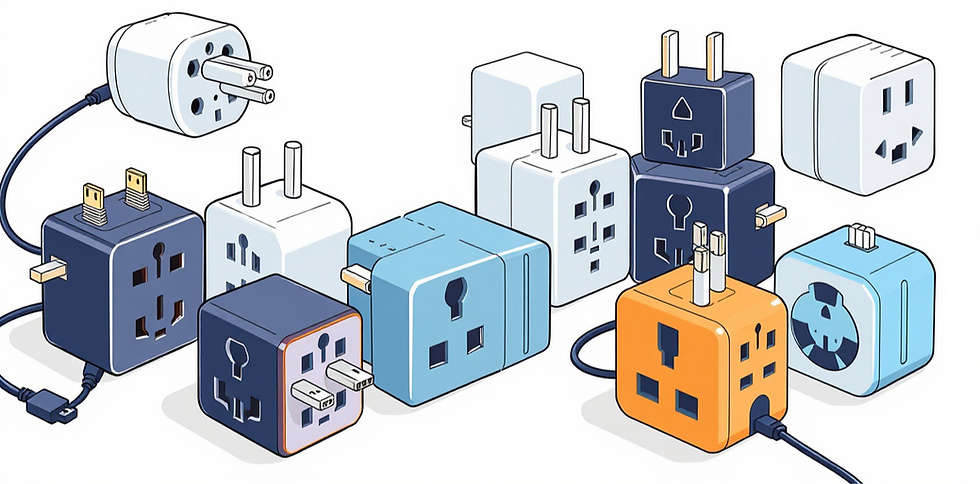
Why does it matter?
Voltage: North America, many Caribbean nations, parts of South America, Taiwan, and Japan use 100-120 volts while most other countries use 220-240 volts.
Frequency: Europe operates at 50 Hz, compared to 60 Hz in the U.S.
If your device operates on a different voltage and frequency than what it is connected to, it may be damaged.
Adapters VS Converters
An adapter allows you to plug your device into a different shaped outlet.
A voltage converter changes the electrical voltage from 220-240v down to 110-120v to protect devices that are designed for U.S. voltage.
Make a list of all the electronic devices you will be bringing with you. (Phone, laptop, tablet, watch, hair dryer, curling iron, electric razor, camera equipment, medical devices such as CPAP machine, etc.) This is a good time to remind yourself to only bring what you really need.
Determine what adapter you need based on where you are traveling using the table below. Be sure to include airport layovers.
Outlet Style | Description | Locations |
Type A & B | Two prongs (Type A) or three prongs (Type B) are found on almost all US devices | US, Canada, Mexico, and Japan |
Type C | Two pins that are rounded, rather than flat | European countries, South America, and parts of Asia |
Type D | Three round pins | India, Pakistan, Bangladesh, and Nepal |
Type E | Two round pins with an additional slot above and/or below the pins for the grounding knob | France, Belgium, Poland, Slovakia, and Czechia |
Type F | Two round pins with an additional slot above and/or below the pins for the grounding knob | Russia and other European countries, except for the UK and Ireland |
Type G | Three flat prongs | UK, Ireland, Malta, Malaysia, Hong Kong, and Singapore |
Type H | Three round prongs set in a lower configuration than the Type D outlet | Israel and Palestine |
Type I | Two or three flat prongs on an angle, rather than straight up and down | Australia, New Zealand, China, and Argentina |
Type J | Three round pins that are placed closely together | Switzerland, Liechtenstein, and Rwanda |
Type K | Two round prongs; one of the two prongs look like a semi-circle | Denmark and Greenland |
Type L | Three prongs set in a row | Italy and Chile |
Type M | Three round prongs set in a triangle | South Africa and Botswana |
Type N | Three prongs set in a semi-circle format | Brazil |
Type O | Three prongs set in a semi-circle format | Thailand |
Determine you device's voltage. A device is either 110-120V, 220-240V, or dual voltage. Look for a label or imprint on your device or its power adapter. It usually lists input voltage and frequency.
100-240V, 50/60Hz means the device is dual voltage
110V, 60Hz means the device is single voltage
Dual Voltage
If your device is dual voltage (marked 100-240V) you only need an adapter. Smartphones, laptops, tablets, CPAP machines, and camera charges are typically dual voltage.
Single Voltage
If your device only supports (110-120V) you will need both an adapter AND a voltage converter. Some hair dryers, electric shavers, curling irons/straighteners, and older electronics may be single voltage.
Tips
Converters come in various wattage ratings. Choose one that matches or exceeds your device’s power consumption.
When in doubt, check the manufacturer’s website or user manual.
Consider a combined adapter and converter if you want a compact solution.
Look for ones that include USB ports.


Comments